Supported models
All LabJack T-series modules have both Ethernet and USB communications. The following models are currently supported.
T4
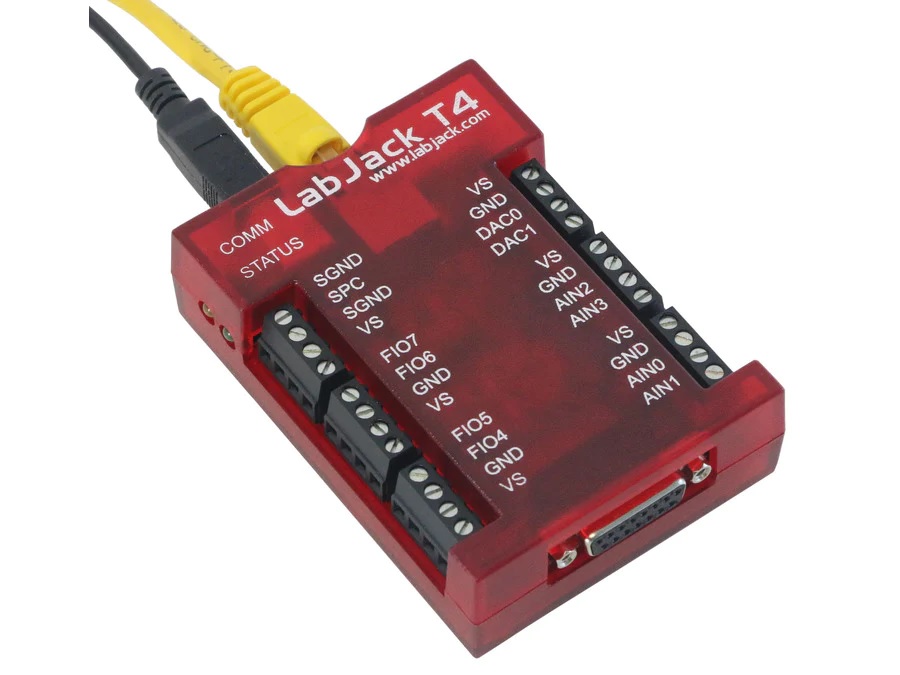
Photo of LabJack-T4
This module costs $245 and has the following features:
- 4 single-ended analog inputs
- +- 10V range
- 12-bit
- Up to 50 kHz total streaming input rate, i.e. 1 channel at 50 kHz, 2 channels at 25 kHz, etc.
- Up to 8 additional analog inputs (0-2.5 V range, 12-bit). These can also be configured as digital I/O bits.
- 2 analog outputs
- 0-5V range
- 10-bit
- Up to 50 kHz streaming output rate
- 20 digital I/O bits
- Each configurable as input or output.
- 8 of these can configured as 0-2.5V analog inputs.
More information can be found in the T4 product description.
T7
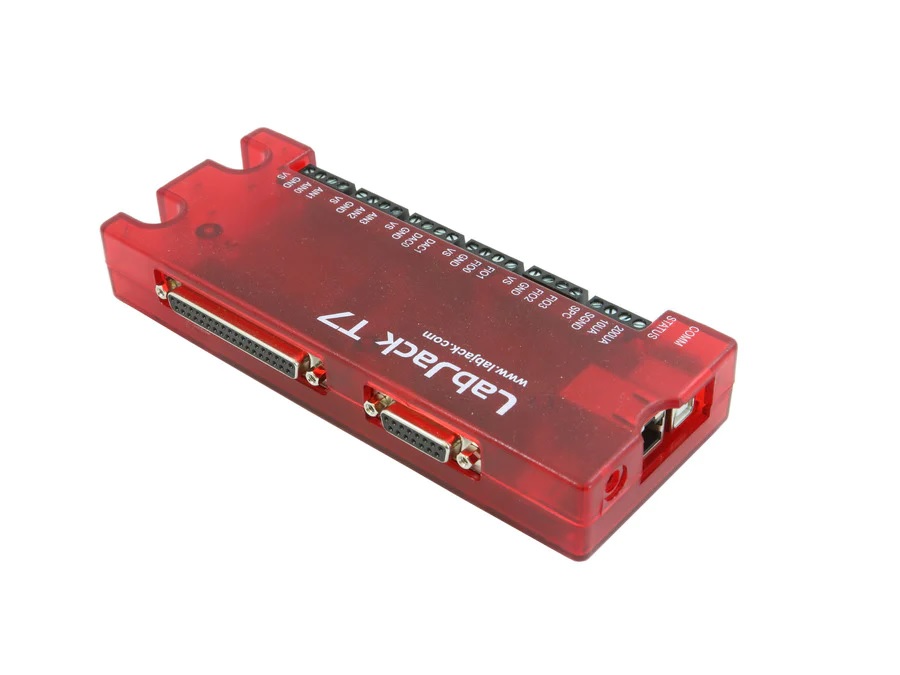
Photo of LabJack-T7
This module costs $520 and has the following features:
- 14 single-ended / 7 differential analog inputs
- Programmable range (+-10V, +-1V, +-0.1V, +-0.01V)
- 16-bit
- Up to 100 kHz total streaming input rate, i.e. 1 channel at 100 kHz, 2 channels at 50 kHz, etc.
- 2 analog outputs
- 0-5V range
- 12-bit
- Up to 100 kHz streaming output rate
- 23 digital I/O bits - Each configurable as input or output.
More information can be found in the T7 product description.
T7-PRO

Photo of LabJack T7-PRO
This module costs $750 and is the same as the LabJack T7 with the following additional features:
- Each analog input can be software switched between 16-bit and 24-bit ADC, trading off resolution for speed.
- In 24-bit mode the ADCs support 9 types of thermocouple inputs.
- WiFi communications (in addition to standard Ethernet and USB).
More information can be found in the LabJack T7-PRO product description.
T8

Photo of LabJack T8
This module costs $1,400 and has the following features:
- 8 differential analog inputs
- 11 input ranges from +-11V to +-0.15 V
- 24-bit sigma/delta ADC
- Supports 9 types of thermocouple inputs
- Up to 40 kHz streaming input per channel, i.e. up to 320 kHz total scanning rate.
- 2 analog outputs
- 0-10V range
- 16-bit
- Up to 40 kHz streaming output rate
- 23 digital I/O bits, each configurable as input or output.
More information can be found in the LabJack T8 product description.